


My Cart (0)
Table of Contents


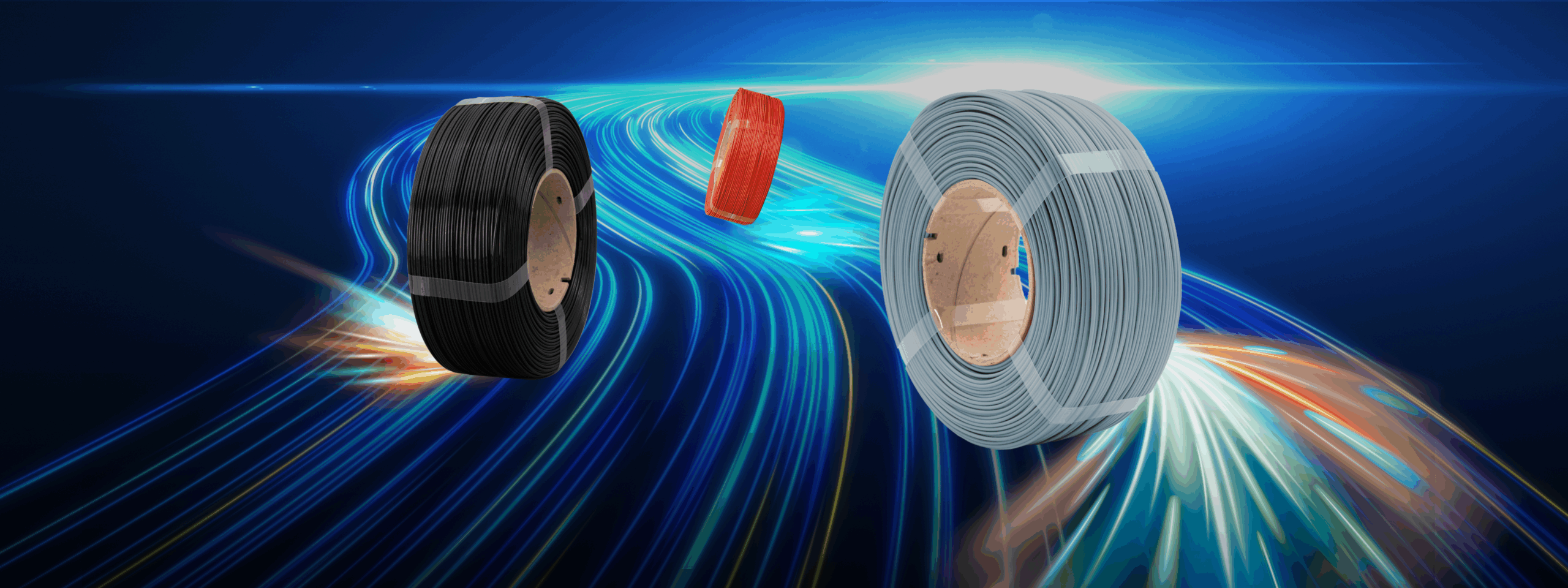
At AzureFilm, we believe innovation often starts with curiosity. Our PETG Original filament has long been a reliable choice for makers seeking strength, durability, and consistent print quality. But recently, we asked ourselves: how fast can it really go?
To find out, we conducted extensive testing—adjusting printer settings, tweaking slicer parameters, and pushing print speeds well beyond the usual limits. The results were impressive: prints that once took hours could now be completed in nearly half the time, all while maintaining the flawless quality our users expect.
This discovery revealed something remarkable: our PETG Original had always been capable of high-speed printing. We simply hadn’t fully explored or communicated this potential until now.
Introducing PETG Hyper Speed
With this insight, we refined our filament’s identity and launched PETG Hyper Speed: the same trusted PETG formula, now officially verified and optimised for high-speed 3D printing. This filament offers the perfect combination of strength, reliability, and speed—ideal for those who want to push their printers to deliver more without sacrificing print quality.

Putting Hyper Speed to the test
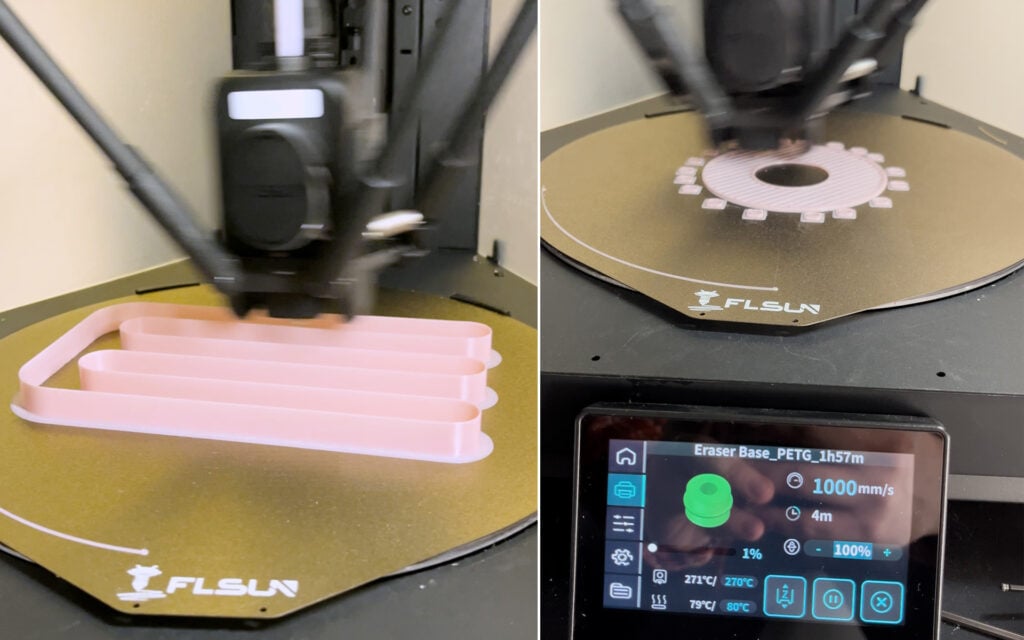
To verify just how far we could push PETG Hyper Speed, we selected one of the fastest consumer 3D printers currently available: the FLSUN T1 Pro. With a rated top speed of 1000 mm/s and a volumetric flow capacity of 90 mm³/s, it provided the perfect benchmark for real-world high-speed performance.
We ran a series of controlled tests—gradually increasing print speed, monitoring extrusion flow, and evaluating print quality at each stage. To our surprise (and delight), PETG Hyper Speed consistently matched the printer’s capabilities, reaching a peak flow rate of 85 mm³/s. That’s nearly the maximum limit of the printer—and it did so without introducing stringing, under-extrusion, or layer inconsistencies.
At standard layer widths and heights, the printer maintained linear speeds of up to 1000 mm/s, delivering clean, strong prints at a pace we didn’t think was possible with PETG.
Understanding volumetric flow limits
While print speed is often measured in millimetres per second (mm/s), true high-speed performance depends on volumetric flow rate—the amount of filament that can be melted and extruded per second, measured in mm³/s. This is the actual limiting factor for any filament under high-speed conditions.
To quantify this, we used a flow rate calculator, which confirmed that under specific layer settings, PETG Hyper Speed could theoretically reach speeds up to 1680 mm/s—a speed no consumer printer can currently achieve, but a clear testament to the filament’s thermal responsiveness and printability.
Real-world printer results
We also tested PETG Hyper Speed on several popular high-performance printers to see how it performed within their respective limits:
FLSUN T1 Pro
- Peak volumetric flow: 85 mm³/s (out of 90 mm³/s max)
- Achieved speed: Up to 1000 mm/s at standard layer settings
- Demonstrated near-maximum throughput, showcasing the filament’s speed potential.
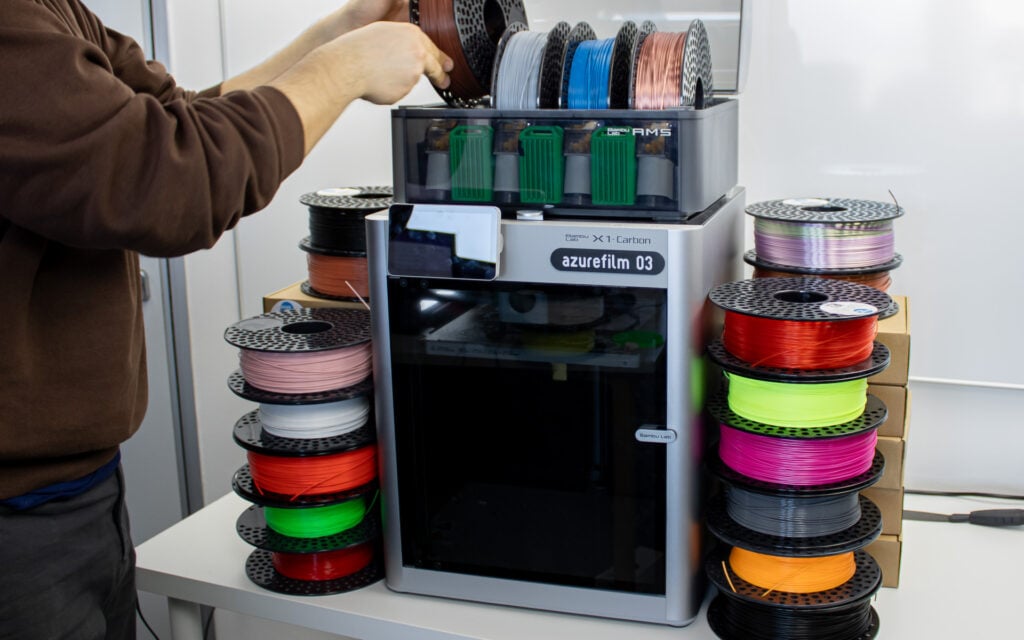
Bambu Lab X1 Carbon
- Achieved Flow Rate: 20 mm³/s (user-tested max: 23 mm³/s)
- Default PETG profiles often limit performance to 12 mm³/s—well below what PETG Hyper Speed can achieve.
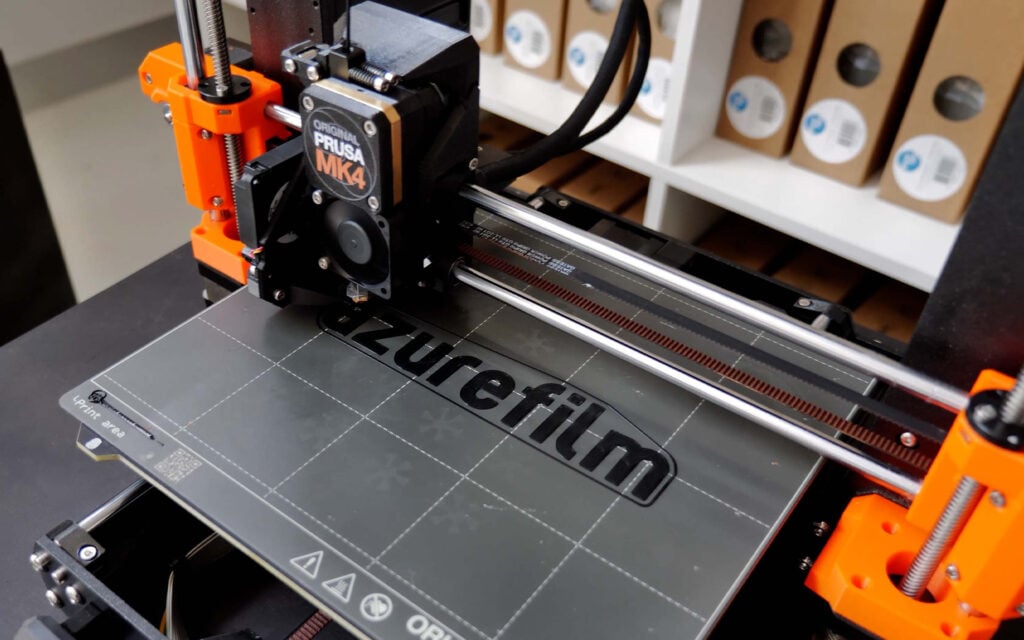
Prusa MK4
- Achieved Flow Rate: 20 mm³/s (default limit: 12 mm³/s)
- With proper tuning, the filament exceeded default thresholds while maintaining print integrity.
Conclusion
These results clearly show that PETG Hyper Speed is not only compatible with fast printing—it thrives on it. By unlocking your printer’s true flow capacity through filament settings, especially on infill and support sections, you can significantly reduce print times.
To get the best balance between speed and quality, we recommend:
- Keeping outer and inner wall speeds at default for optimal surface finish
- Maximising infill speed where visual quality matters less
- Staying within your printer’s manufacturer-defined limits for long-term reliability
While some high-speed filaments trade mechanical strength for print speed, PETG Hyper Speed maintains excellent structural properties, even when operating near the upper edge of your printer’s capabilities.
Now there is only one thing left for you to do! Shop our PETG Hyper Speed!
Happy printing!
Share


 Previous post