-30%
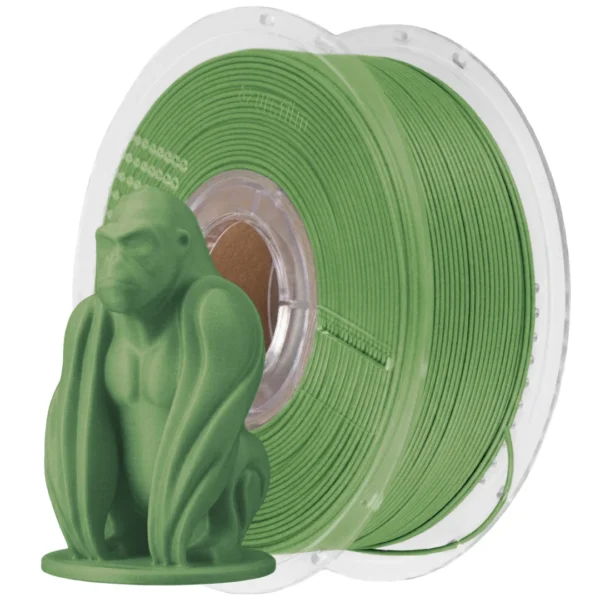
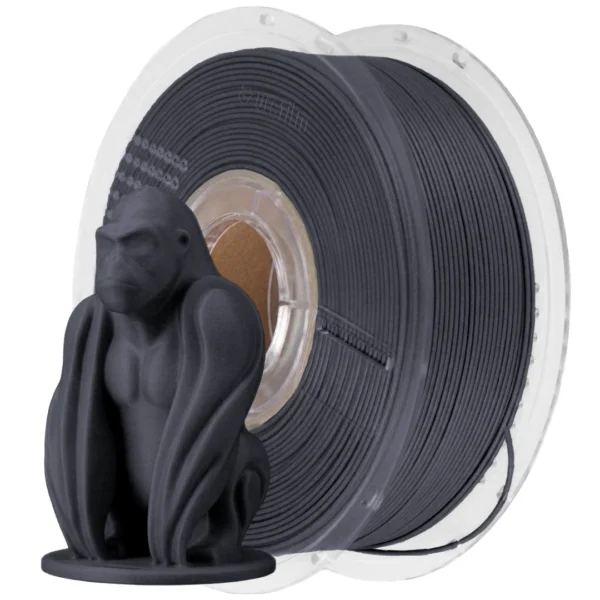
Explore AzureFilm carbon fiber filament for strong, lightweight and dimensionally stable technical parts. Carbon-fibre reinforced materials are ideal for functional prototypes, robotics, automotive and industrial applications.

Effect
Level
Materials
Type
Color
Carbon fiber filament, often called CF filament or carbon fiber 3D printer filament, is a composite material in which short carbon fibers are mixed into a thermoplastic base polymer. The carbon fibers change the behaviour of the base material, typically increasing stiffness and dimensional stability while creating a characteristic matte, technical surface. Because the properties of the finished filament depend strongly on the base polymer, not all carbon fiber filaments should be treated as the same material.
A carbon-fiber-reinforced PLA, PETG, PET or polyamide can have very different heat resistance, toughness, moisture sensitivity and printing requirements. The correct CF filament should therefore be selected first by the base polymer and then by the additional benefits of the carbon fiber reinforcement.
Carbon fiber reinforcement is especially useful when a printed part needs higher stiffness, reduced flex and good dimensional stability. CF filaments can also show lower visible layer lines and a professional matte finish, which makes them attractive for technical prototypes and exposed functional parts. In many formulations, the reinforcement helps reduce shrinkage and improve shape retention during and after printing.
Carbon fiber does not automatically make every filament stronger in every possible way. Increased stiffness can come with reduced elongation or impact toughness, and the final mechanical performance depends on fiber content, fiber geometry, polymer matrix, print orientation and process settings. For structural applications, technical data and part testing are more meaningful than general statements about carbon fiber strength.
AzureFilm carbon fiber materials cover different performance levels and use cases. Carbon-fiber-reinforced PLA is suited to users who want easy printing, high stiffness and a refined matte surface. PETG CF offers a tougher base polymer for functional parts that need a different balance of durability and printability. Carbon Fiber PET is intended for more technical applications where dimensional stability and higher temperature performance are important, while Carbon Fiber PAHT uses a high-temperature polyamide base for demanding mechanical and thermal environments.
This base-material approach keeps the category flexible as new CF formulations are introduced. When choosing a carbon fiber filament, consider heat exposure, required stiffness, impact loads, chemical environment, moisture sensitivity and printer capability. The most advanced material is not automatically the best option if a simpler base polymer already meets the requirements of the part.
CF filament is commonly used for functional prototypes, jigs, fixtures, brackets, tooling, robotics components, drone parts, lightweight mechanical elements, enclosures, automotive prototypes and other parts where rigidity and dimensional stability are important. It can also be useful for presentation models that benefit from the matte carbon-fiber appearance.
For highly loaded or safety-critical components, printed carbon fiber composites must be validated for the actual load case. Layer orientation, wall count, infill strategy, nozzle temperature and annealing or post-processing can all influence the final performance of the part.
Carbon fiber filaments are abrasive. Standard brass nozzles can wear quickly, which changes nozzle diameter and print accuracy. Use an abrasion-resistant nozzle such as hardened steel, ruby or tungsten carbide when printing CF materials. A larger nozzle is often recommended for fiber-filled filaments because it reduces the risk of clogging, but the exact nozzle diameter should follow the recommendations for the specific product.
Printing temperature, heated-bed requirements and enclosure needs are determined primarily by the base polymer. PLA CF may print on comparatively simple machines, while high-temperature polyamide-based CF materials require significantly more capable hardware and careful moisture control. Carbon-fiber-filled materials should be kept dry, especially when the base polymer is hygroscopic.
AzureFilm carbon fiber filament options allow users to choose CF reinforcement across multiple base materials rather than relying on one universal formula. This makes it possible to select an easier-printing carbon fiber filament for visual and rigid parts or a more advanced engineering composite for higher mechanical and thermal requirements.
For the best result, choose the base polymer first, confirm that the printer can reach the required temperatures, use an abrasion-resistant nozzle and follow the drying and printing recommendations for the specific carbon fiber filament.
No products in the cart.