

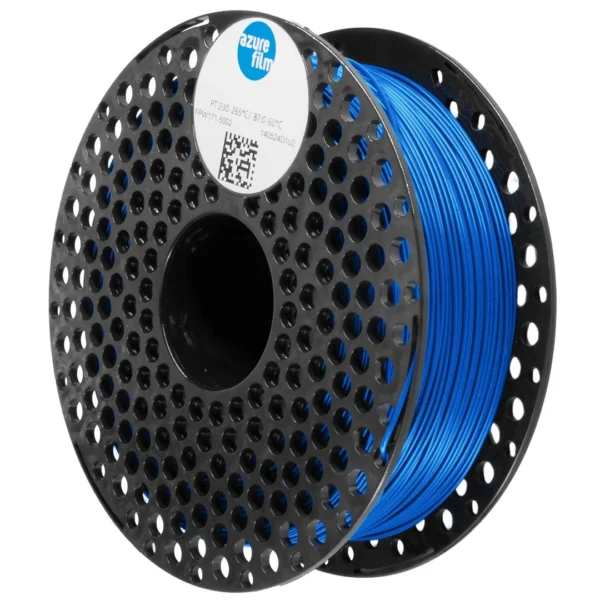
TPU FLEXIBLE 3D PRINTER FILAMENTS: Choose your TPU filament for flexible and durable 3D prints
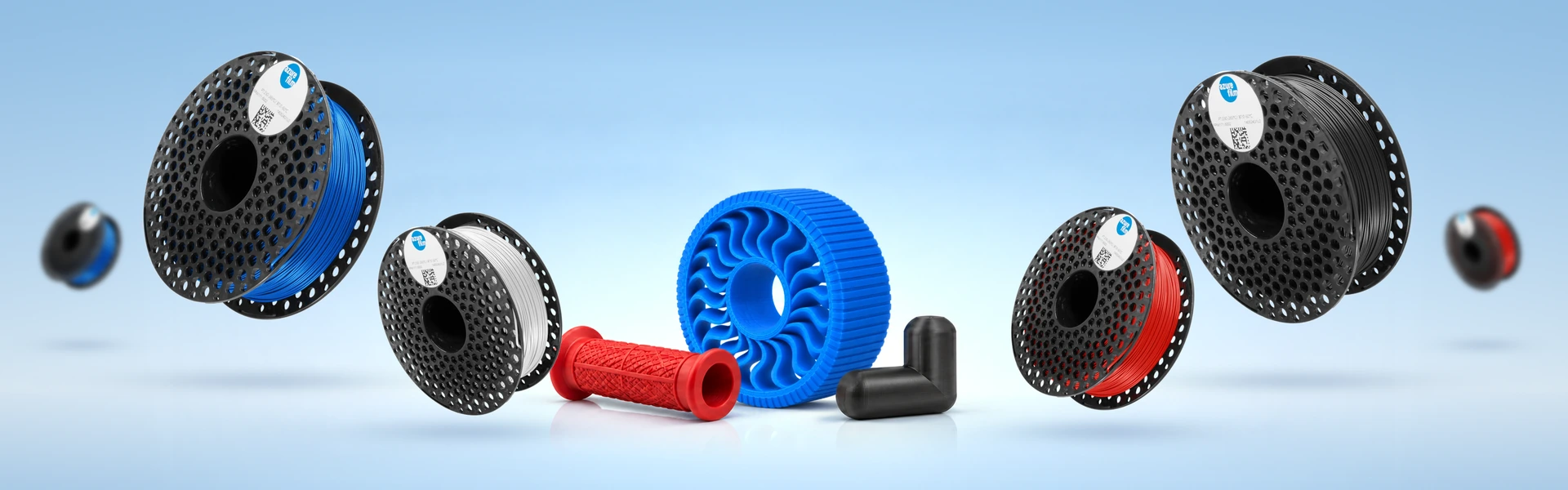
Shop AzureFilm TPU filament for flexible, elastic and impact-resistant 3D printed parts. Ideal for seals, grips, protective components, flexible connectors and projects that need bend rather than break.
Effect
Level
Materials
Type
Color
Filter
Effect
Level
Materials
Type
Color
Sort By
TPU FLEXIBLE 3D PRINTER FILAMENTS: Choose your TPU filament for flexible and durable 3D prints
What is TPU filament?
TPU filament, or thermoplastic polyurethane, is a flexible 3D printing filament that combines rubber-like elasticity with the processability of a thermoplastic. It can bend, stretch and compress without behaving like a rigid material such as PLA, PETG or ABS. This makes TPU one of the most useful FDM and FFF materials for parts that need flexibility, impact absorption, grip or repeated movement.
TPU belongs to the broader family of thermoplastic elastomers, often referred to as TPE materials. In everyday 3D printing, TPU is the most common flexible filament because it offers a useful balance of elasticity, durability and printability. Different formulations can feel very different, which is why Shore hardness is an important part of choosing the correct TPU.
Understanding TPU Shore hardness
TPU filament is available in different Shore hardnesses. A lower Shore A value generally means a softer, more elastic material, while a higher Shore A value means a firmer TPU that is easier to feed and behaves more like a semi-flexible plastic. This allows the same material family to cover applications ranging from very soft grips and flexible seals to tougher protective parts and components that need controlled flex rather than maximum softness.
Shore hardness should be chosen according to the final part and the printer. Softer TPU provides greater flexibility but is more demanding to feed through the extrusion path. Firmer TPU is usually easier to print and can often be handled by a wider range of extruder systems. By focusing on hardness and end use rather than a fixed list of individual products, TPU remains a flexible material category even as new formulations are added.
TPU filament properties and applications
TPU 3D printer filament is valued for flexibility, abrasion resistance, impact absorption and resistance to repeated bending. Many TPU formulations also offer useful resistance to oils, greases and wear, although chemical resistance should always be checked for the exact material and application.
Common TPU applications include protective cases, seals, gaskets, grips, feet, bumpers, vibration dampers, flexible hinges, wearables, cable management, rollers, wheels, soft-touch components, robotics parts and functional prototypes. TPU is also useful when a rigid printed part would crack or transmit too much vibration.
How to print TPU filament
Flexible filament behaves differently from rigid filament inside the printer. The more the TPU can compress and buckle, the more important a short and well-constrained filament path becomes. Direct-drive extruders are generally the easiest solution for soft TPU because the drive gears sit close to the hot end. Firmer TPU can also work well in other extrusion systems when the filament path is properly supported and the printer is tuned for flexible materials.
A steady feed rate is more important than simply aiming for the slowest possible print. Modern printers and TPU formulations can support very different speeds, so generic speed limits quickly become outdated. Start with the recommended profile for the exact TPU and then tune flow, acceleration and speed according to print quality. Excessive retraction can cause jams or inconsistent feeding, so flexible materials often benefit from shorter and less aggressive retraction than rigid filaments.
TPU moisture, adhesion and print quality
TPU is hygroscopic and can absorb moisture from the air quickly. Wet TPU may produce bubbles, excessive stringing, rough surfaces and inconsistent extrusion. Store flexible filament in a sealed dry environment with desiccant and dry it according to the product recommendations before critical prints or whenever moisture symptoms appear.
Good first-layer adhesion is important, but TPU can bond very strongly to some print surfaces. Use the build-surface preparation recommended for the printer and filament so the part can be removed without damaging the plate. Cooling, nozzle temperature and layer height should be tuned to the hardness and geometry of the part.
Why choose AzureFilm TPU filament?
AzureFilm TPU filaments are designed to cover different levels of flexibility and application needs. By choosing the appropriate Shore hardness, users can move from softer, highly elastic parts to firmer flexible components that are easier to print and provide more structural support.
Choose TPU when the final part needs to bend, absorb impact, reduce vibration or provide a soft-touch surface. For the most reliable results, match the hardness to the application and printer, keep the filament dry and use a well-supported extrusion path.