

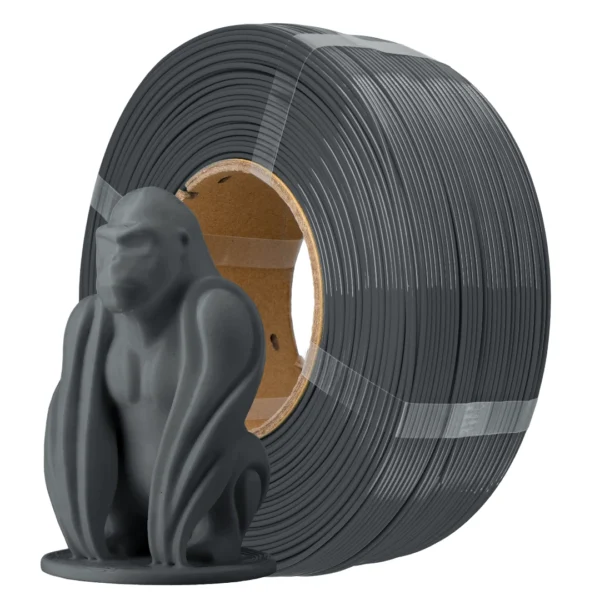
PCTG FILAMENTS: Choose your PCTG 3D printer filament for strong and durable technical projects
Explore AzureFilm PCTG filament for tough, durable and odourless 3D prints. PCTG offers a useful balance of strength and flexibility with higher temperature resistance than standard PETG.
Effect
Level
Materials
Type
Color
Filter
Effect
Level
Materials
Type
Color
Sort By


PCTG FILAMENTS: Choose your PCTG 3D printer filament for strong and durable technical projects
What is PCTG filament?
PCTG filament is a copolyester 3D printing material related to PETG but formulated for a different balance of toughness, impact resistance, clarity and temperature performance. The name PCTG refers to a glycol-modified polycyclohexylenedimethylene terephthalate material. In FDM and FFF 3D printing, PCTG is used when users want the practical printability of a copolyester together with stronger mechanical performance for functional parts.
PCTG can be a useful alternative to PETG for applications where impact resistance, ductility and dimensional stability are especially important. It is generally suited to users who want a robust technical filament without the printing requirements of high-temperature nylons or other advanced engineering polymers.
PCTG filament properties and advantages
One of the main advantages of PCTG filament is toughness. Well-printed parts can tolerate impact and deformation better than more brittle materials, which makes PCTG useful for protective parts and functional components. It also offers low shrinkage, good layer adhesion and good chemical resistance for many everyday applications.
PCTG is available in transparent and opaque formulations. When transparency matters, print settings, wall thickness, layer direction and post-processing all influence the final optical result. A transparent filament does not automatically produce glass-clear 3D prints, but PCTG can achieve attractive translucent or transparent effects when the model and settings are optimised for that purpose.
What is PCTG filament used for?
PCTG 3D printer filament is suitable for functional prototypes, mechanical parts, housings, protective covers, fixtures, robotics components, containers and parts that benefit from a combination of toughness and dimensional stability. Its ductility can be particularly useful for clips, snap-fit elements and components that need to absorb impact rather than crack suddenly.
Material suitability always depends on the actual operating conditions. For parts exposed to elevated temperature, chemicals, repeated mechanical load or regulated applications, verify the technical data for the specific filament and test the printed part under realistic conditions before final use.
PCTG vs PETG
PCTG and PETG are both copolyester filaments and share several printing characteristics, but they should not be treated as identical materials. PCTG is often selected when higher toughness, impact resistance or a different balance of heat resistance and flexibility is required. PETG remains an excellent general-purpose choice and may be easier to source in a broader range of colours and formulations.
The better material depends on the project. Choose PETG for versatile everyday functional printing and PCTG when the part benefits from increased toughness, ductility or clarity. The exact difference will vary between formulations, so technical data and real-world testing are more useful than relying only on the material name.
How to print PCTG filament
PCTG typically prints at higher nozzle temperatures than standard PETG and generally benefits from a heated bed. A stable first layer and clean print surface help minimise warping and lifting. Most PCTG does not require a heated chamber, although a stable ambient temperature can improve consistency on large technical parts.
Because PCTG can absorb moisture, dry filament is important for smooth extrusion and strong layers. Stringing or surface bubbles are often signs that the filament has taken up moisture. Retraction, cooling and print speed should be tuned together rather than adjusted independently, especially on detailed parts.
Why choose AzureFilm PCTG filament?
AzureFilm PCTG filament is intended for users who need a durable copolyester for functional and technical 3D printing. It offers an alternative between general-purpose PETG and more demanding engineering materials, with a focus on toughness, low warping and dependable dimensional performance.
For the most reliable results, select PCTG according to the mechanical and visual needs of the part and use the recommended settings for the exact filament and printer combination.